What can I expect when it comes to contact?
What rights you have, what is customary and what you should record when a contact time does not take place.
A log does not become good by being detailed. It becomes good when it is easy to follow. The difference comes down to a few words per entry.
Published on

A log is meant to be read later by someone who was not there. That person knows neither you nor the other parent nor the history. They read what is on the page.
That is why a short, verifiable entry carries more weight than a long account. If you describe, you give the reader the chance to form their own picture. If you judge, you take that chance away and put yourself at the centre instead.
There is a practical reason too: one sentence per event is something you will still write when the day has been exhausting. A paragraph you write twice, and then you stop.
Five pieces of information, and in most cases that is all it takes:
What matters is when you wrote it down. An entry made the same evening is something quite different from a list written a year later from memory. So record when you made the note, not just what it was about.
It is usually the same few kinds of words that devalue an otherwise good entry.
A rule of thumb: if a sentence still holds true when the other parent reads it, it is well worded.
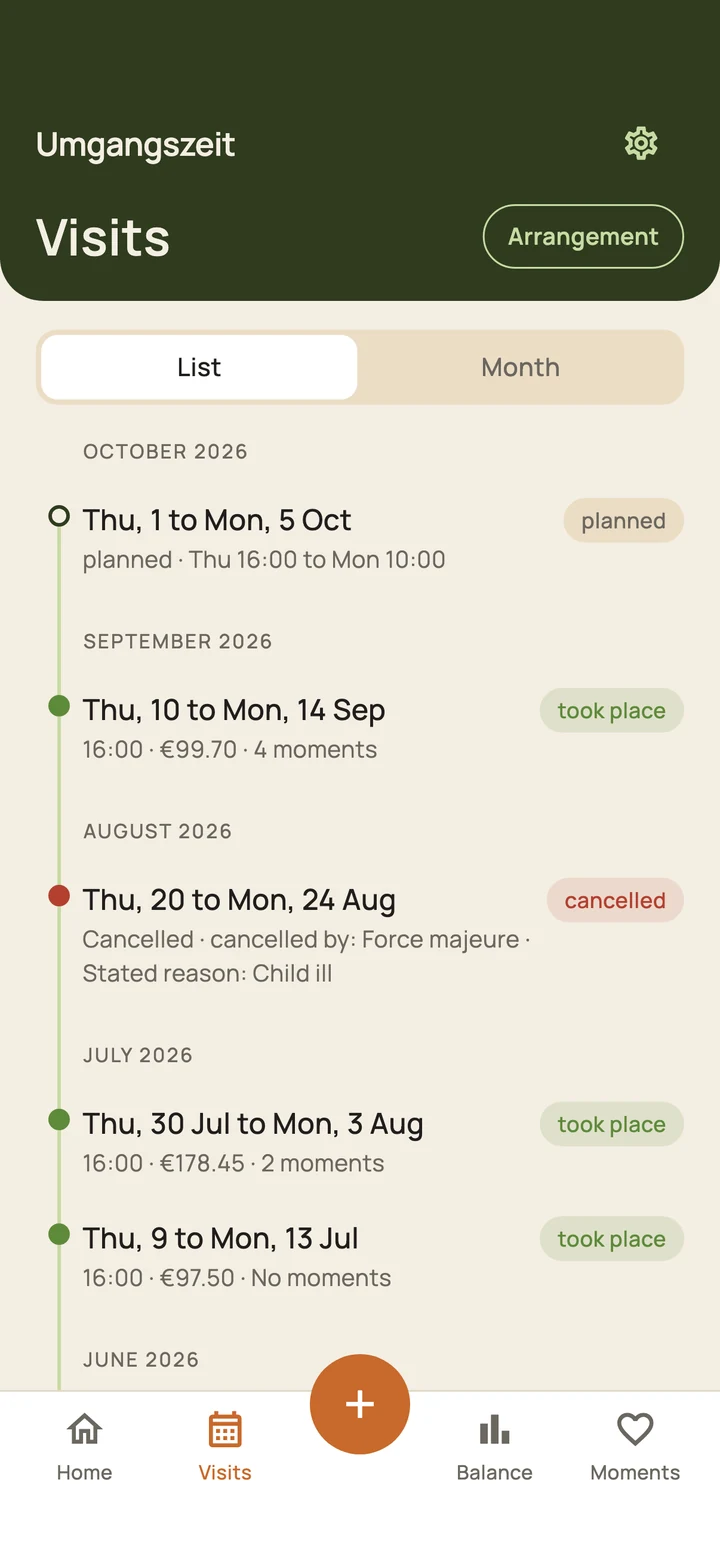
The contact time from 13 to 17 August is cancelled. The cancellation arrives the evening before, by message.
Judgemental: "Cancelled yet again, last minute of course. Supposedly ill, as always when it doesn't suit her. Mia must have been completely crushed by it."
Factual: "12 Aug, 19:32: message from the child's mother, the contact time from 13 Aug to 17 Aug will not take place. Reason given: Mia is ill. No replacement date was offered. I replied on 12 Aug at 19:50 and proposed a replacement date for the weekend of 22 to 24 Aug. No reply by 17 Aug. Train ticket for 13 Aug had been booked, 112.90 euros, no refund."
The second entry is shorter in tone and longer in what it proves. It contains the time, the wording of the reason, your own response and the loss you incurred. It passes no judgement anywhere. And that is exactly why it works.
Most logs fail not because of the language but because of the three-week gap in the middle. A log with gaps is weaker than one that is brief but complete.
What helps: tie it to fixed points instead of resolving to write regularly. One entry after every handover. One entry after every cancellation, straight away, while the wording is still fresh. Nothing else.
And separate what you keep for yourself from what you may one day have to show someone. The lovely things your child says belong in a memory book, not in a case file.
What rights you have, what is customary and what you should record when a contact time does not take place.
Why the happy moments do not belong in the documentation, what goes into an entry and how to keep it going.
Umgangszeit records exactly what this guide is about: contact times, cancellations, costs and moments, in chronological order and on your phone.
Join the waiting list