Keeping a contact log: factual, not judgemental
Why short, sober entries are worth more than long ones, and which wordings work against you.
Between two contact times, more fades than you would think. Not the big days, the small sentences. A memory book holds on to them, and it is something different from your documentation.
Published on

You write a contact log for someone who was not there: factual, verifiable, without interpretation. You write a memory book for yourself and for your child. That is where there is room for what moved you.
Keeping the two apart is not a formality. If you write both into one file, you get two problems at once. The documentation goes soft because feeling gets mixed in. And the good moments suddenly sit in a document that you will one day hand to someone who has no business reading them.
So: two places. What is meant to prove something belongs in the documentation. What is meant to last belongs in the memory book.
A memory entry needs very little. A date and a sentence are usually enough.
What does not belong in it: the other parent. Not because they never come up, but because that is what tips a memory book over. As soon as it collects accusations, it is no longer a memory book.
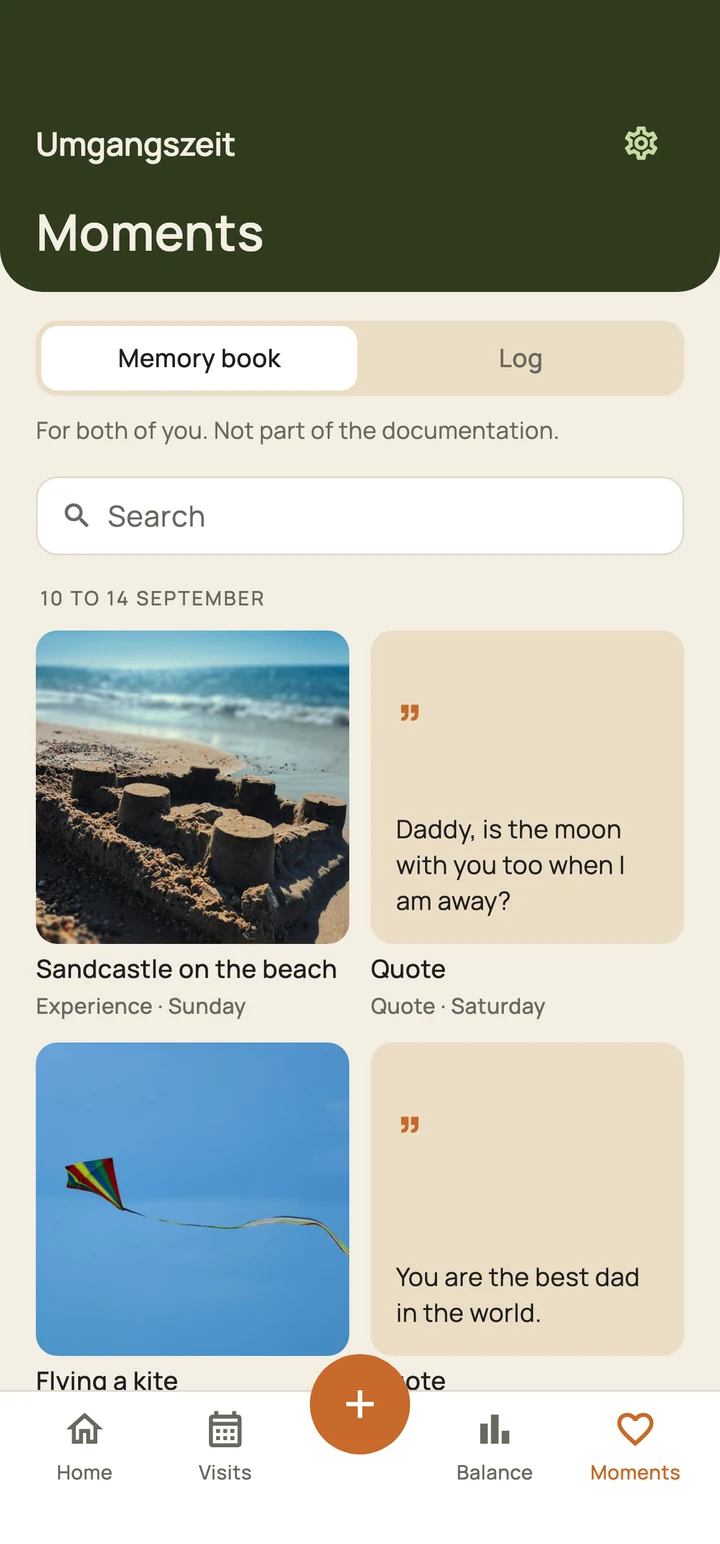
"She said something sweet about the moon" is worth nothing in two years. The sentence itself is. Children put things differently from adults, and that exact wording is what disappears.
So write in quotation marks what you still remember exactly, and in your own words what you only remember roughly. This distinction costs nothing and keeps the book honest later on.
Memory books rarely fail at the start. They fail after six weeks.
It belongs to both of you. Many parents read to their child from it when the child is older, others hand it over on a birthday. Both work, as long as your child finds nothing in it that draws them into a conflict.
A memory book is not evidence and is not meant to become evidence. It is the part of your contact time that nobody has to check.
Why short, sober entries are worth more than long ones, and which wordings work against you.
What you can do together when little is left after the journey and a second household.
Umgangszeit records exactly what this guide is about: contact times, cancellations, costs and moments, in chronological order and on your phone.
Join the waiting list